

Welcome to the 17th newsletter for 2026!
A quick note before we get started: If you are new here, welcome. I use this space to write through what I am seeing and learning across warehouse design and automation as the industry evolves.
The Either/Or That Wasn't There
A quick note before I get into this week's piece.
MHI used the MODEX opening keynote to announce MODEX West - a new show debuting October 18-20, 2028 at the Las Vegas Convention Center. It doesn't replace Atlanta. The original MODEX continues April 3-6, 2028. With ProMat still running opposite years in Chicago, that puts three major MHI shows in an 18-month window from spring 2028 to spring 2029.
That's a lot of show capacity being added to an industry that's supposedly being disrupted by software. Worth sitting with.
For now, the thing I actually want to write about from the floor.
I walked into MODEX wrong.
I expected the shiny object to have taken over.
Six months of LinkedIn feeds, vendor decks, and enterprise AI pitches had set the frame. Every conversation about warehouse automation was bending toward agents, copilots, and autonomous everything. I figured the floor would reflect that. A sea of AI-first software booths. Robotics companies repositioning themselves as "AI platforms that happen to have hardware." Humanoids center stage. The industry finally or prematurely conceding that the next decade belongs to software.
That's not what I saw.
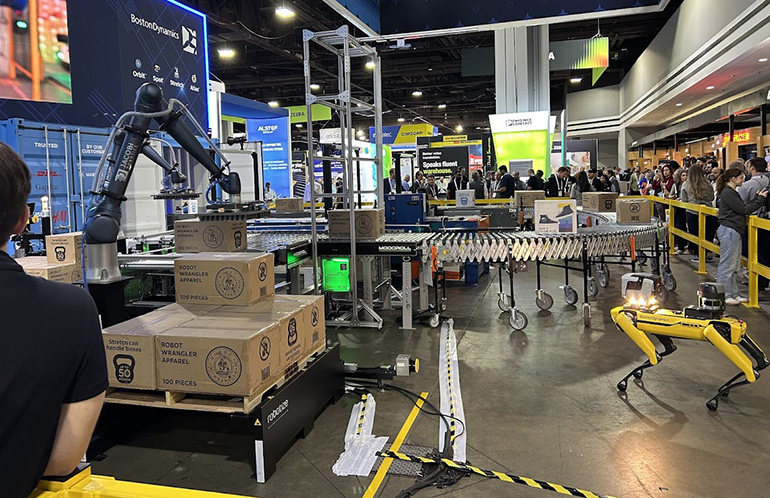
The biggest booths were still moving pallets, totes, and eaches. Brightpick used MODEX to unveil Gridpicker - a brand new high-density grid-based system built on their Autopicker platform. Locus launched Locus Array, a new tower-style mobile manipulator that picks directly from standard racking. Automated forklifts were everywhere. These weren't incremental refreshes of last year's product line. These were new physical platforms. Vendors bet capital on metal.
AI was everywhere too. But not where I expected to find it.
It wasn't standing opposite automation. It was inside it. Embedded into orchestration layers, perception stacks, fleet coordination, exception handling. Nobody was pitching AI as an alternative to physical automation. Nobody was saying "you don't need robots anymore, you need agents." The either/or framing that dominates my feed didn't exist on the floor.
I also want to name something that wasn't there, because I think it matters.
No humanoids at the center of gravity.
Humanoids are the purest version of the AI-replaces-automation story. They're the shiny object in its most concentrated form - general-purpose, software-defined, the robot as a universal labor substitute. If MODEX was going to pivot to that future, humanoids would have been the headline.
They weren't.
Agility had Digit at booth B9602, standing on a display pedestal in front of a wall that said "Made for work." It drew a crowd. People took photos. Digit was one of the most photographed robots at the show and, as far as I could tell, one of the few that wasn't doing any work. Meanwhile, ten aisles over, Brightpick's Gridpicker and Locus's Array were picking and moving totes in live demos, hour after hour.
That contrast is the story. The most visible humanoid at the biggest materials handling show in North America was a photo opportunity. The purpose-built mobile manipulators were doing the work. Nobody on the floor was pretending otherwise, including, to Agility's credit, Agility. They didn't fake a pick demo to stay competitive with the narrative. They brought what they have.
The humanoid thesis isn't dead. But on the floor, in April 2026, it isn't the answer to the question operators are actually asking. The industry knows the difference between a photo op and a fulfillment system, even if the discourse sometimes forgets.
Here's what I think is actually happening.
The industry isn't choosing between AI and automation. It's figuring out that AI makes the case for automation stronger, not weaker.
Better perception means robots can handle SKUs they couldn't touch two years ago. Better orchestration means fleets can run denser without cascading into recovery. Better vision means picking-in-motion, dynamic slotting, and exception routing that doesn't need a human in the loop for every edge case. None of that removes the need for a machine to physically move the tote. It expands what the machine can do once it's there.
The software-only crowd is solving a different problem - planning, forecasting, slotting optimization, predictive maintenance. Real problems, real value. But those tools sit on top of an operation, not in place of one. And an operation is still a physical thing. Cases still need to move. Pallets still need to be built. Orders still need to ship.
You can't ship a dashboard.
The honest complication.
The AI-only players probably weren't there in force because their buyers aren't there in force. MODEX is a materials handling show. CIOs evaluating enterprise AI platforms are at NRF, Gartner, maybe Money20/20 for the fintech-adjacent plays. The read from my week in Atlanta isn't "AI lost." It's "AI didn't show up as a competitor to automation in the room where automation buyers gather."
That's a narrower claim. But it's the true one. And it's still telling.
Because if the AI-replaces-automation thesis were as strong as LinkedIn says it is, you'd expect the software players to be flooding the automation shows, hunting for share. They weren't. Either they know the floor isn't their buyer, or they know the thesis doesn't hold up in front of operators who actually ship orders. Probably both.
What this means if you're evaluating automation right now.
The industry just told you, quietly and in physical form, that the next several years are still a hardware story with a software wrapper, not the other way around. Vendors are launching new robots, not pivoting to pure software. The serious AI investment is going into making those robots capable of more work, not into replacing the need for them.
If you've been waiting on automation decisions because you thought AI was going to render the question obsolete, it isn't. The question is the same one it's always been. It's just that the answer is getting better.
And if the robots aren't the problem and on a well-run floor, they almost never are, then the work is still where it's always been. Inside the organization. In readiness, ownership, integration, and the capability to absorb what you buy.
MODEX was a reminder that the physical world doesn't care about discourse cycles.
See you next week.
- Parth
P.S. Two other things from the floor I'm still chewing on. The metal vs. plastic tote debate - I walked in skeptical of metal and left reconsidering. And a shift in how operators are talking about their system integrators that I don't think is getting enough attention yet. Both coming in the next few weeks.
News
Thoughts? Questions? Feedback? Reply to this email.